



A survey by Instrumentarium conducted in five Finnish cities (n=604) reveals that most children do not wear sunglasses on sunny summer days. “It’s important for parents to understand that a surprisingly large share of lifetime UV exposure accumulates during childhood,” says Instrumentarium optometrist Ritva Kahlos.
With Midsummer approaching and UV radiation reaching its peak, protecting children’s eyes is especially important. Children’s eyes are more sensitive to UV radiation than those of adults.
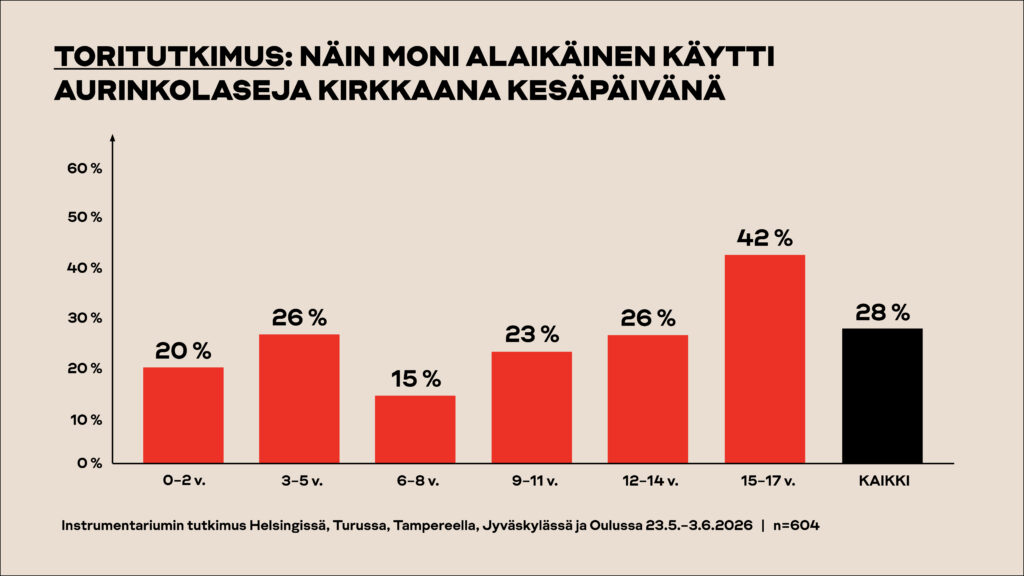
Instrumentarium carried out an observational street survey in Helsinki, Turku, Tampere, Jyväskylä, and Oulu, assessing sunglasses use among minors on a sunny day. The findings were striking: only 28% of children aged 0–17 were wearing sunglasses.
“Far too few children were wearing sunglasses. Parents need to step up. During summer, every child’s eyes should be protected from the sun,” Kahlos emphasizes.
Why is eye protection important for children?
Children’s eyes allow more UV radiation to reach the inner parts of the eye than adult eyes do. This is because children typically have larger pupils and clearer lenses. As a result, their eyes are more vulnerable to damage.
“Sunglasses should be treated the same way as sunscreen—they are essential protection against UV radiation.”
Sudden, intense UV exposure can damage the surface of the eye, causing conditions such as photokeratitis (sunburn of the eye or snow blindness). The risk is particularly high near water, where sunlight is reflected into the eyes.
“Surface damage is not easily visible, and children may not link symptoms like pain or irritation to sun exposure. As a result, mild damage often goes unnoticed.”
“The eyes have a lifelong memory”
The good news is that UV-related surface damage usually heals within a few days. However, cumulative exposure over time is a more serious concern.
“The eyes have a lifelong memory, just like the skin. If children are not protected during their most sensitive years, a significant amount of UV exposure can accumulate early in life,” Kahlos explains.
High UV exposure may accelerate structural changes in the eye that only become apparent later in adulthood. Long-term exposure is associated with an increased risk of cataracts and may also contribute to age-related macular degeneration.
Toddlers and elementary school students wear sunglasses the least
Instrumentarium’s research revealed clear differences between age groups. Toddlers and elementary school children were the least likely to wear sunglasses.
“Babies in strollers often lie in a position where hats don’t provide sufficient protection. Although young children may take their sunglasses off easily, it’s important to consistently encourage their use. Sunglasses are the most effective way to protect against glare and UV radiation.”
Elementary school-aged children, on the other hand, may simply forget their sunglasses or choose not to wear them as they become more independent.
“It’s up to adults to highlight the importance of eye protection and help children find sunglasses they actually enjoy wearing.”
“In the teenage years, sunglasses often return for style reasons—which is great, as long as they provide proper protection. Lenses should be CE-marked and filter UV radiation. Dark lenses alone are not enough, whereas even high-quality lighter lenses usually provide UV protection.”
What to look for in children’s sunglasses
Eye protection is recommended when the UV index reaches 3 or higher. This information is available, for example, on the Finnish Meteorological Institute’s website.
When choosing sunglasses for a child, Kahlos recommends:
- The lenses are labeled UV100% or UV400, blocking 100% of UV radiation
- The sunglasses fit well and stay securely in place
- The frames provide protection from the sides and above
- Sunglasses are complemented with a wide-brimmed hat or a cap
About the research
Instrumentarium’s research (n=604) on sunglasses use among minors was conducted between May 23 and June 3, 2026, iHelsinki, Turku, Tampere, Jyväskylä, and Oulu. Observations were made in central public locations, including Kansalaistori in Helsinki, Market Squares in Turku and Oulu, and key city areas in Tampere and Jyväskylä.
Each city contributed 100–160 observations of individuals aged 0–17. Data recorded included estimated age and whether the individual was wearing sunglasses. Age was confirmed when possible by asking the individual or their guardian.
Research results
This is how many minors wore sunglasses on a bright summer day:
- Ages 0–2: 20%
- Ages 3–5: 26%
- Ages 6–8: 15%
- Ages 9–11: 23%
- Ages 12–14: 26%
- Ages 15–17: 42%
Total: 28%
More information
Ritva Kahlos
Optometrist
ritva.kahlos@instru.fi
040 647 4493
Elena Pallaskivi
Communications Manager
Instru Optiikka Oy
040 7771445
viestinta@instru.fi
Instrumentarium
Instrumentarium is a specialty optical retail chain owned by Instru Optiikka Oy. There are nearly 150 Instrumentarium stores in Finland and 29 in Estonia. Customers are served by over 200 expert optometrists and opticians. Many stores also feature an ophthalmologist’s office. Instrumentarium also operates nine dry eye clinics. Instru Optiikka Oy is part of EssilorLuxottica.