
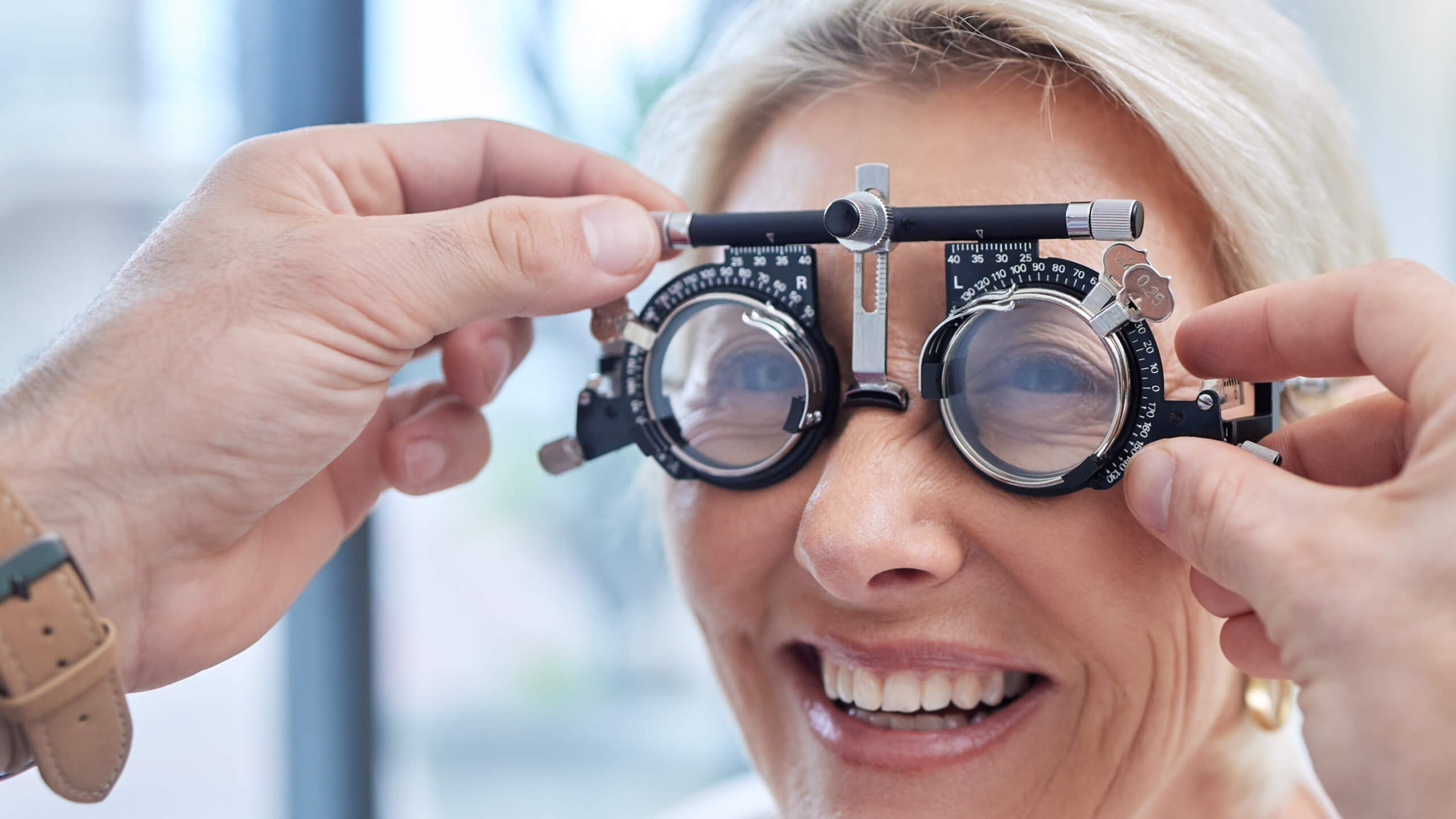
Provision of publicly funded eye care services at an optical retailer
NÄE ry has compiled guidelines for services related to the diagnosis, treatment, and follow-up care for diabetic retinopathy, glaucoma, age-related macular degeneration, and cataracts in the optical retail setting. The guidelines were compiled by an expert working group consisting of optometrists, physicians, vision physiologists, and healthcare process specialists, among others.
These guidelines serve as a resource for public entities when preparing service voucher, registration procedure, or public bids, as well as a guide for optical stores regarding the minimum resources, expertise, and equipment they must have in order to effectively participate in the provision of publicly funded health care services.
These guidelines are intended to assist those who plan and provide publicly funded contracted services. The guidelines are not binding and do not limit the ability of service providers to act differently if they so choose.
Key principles
The fundamental principle behind services provided through service vouchers and/or the registration process is to engage the largest possible group of providers who meet the established criteria in service delivery. The fundamental principle underlying the guidelines in this recommendation is that they must not unnecessarily exclude from service provision facilities that have the tools, expertise, and resources to provide services.
These guidelines have been prepared so that existing structures and processes can be utilised in service delivery as-is or with minimal changes, whenever possible.
The specification has been drafted in such a way that it is not tied to currently prevailing practices and technologies in its details. These guidelines should enable the continuous development of practices, processes, and technologies.
These guidelines adhere to the potential operating practices and division of labour as defined within the scope of a service provider under the Private Health Care Act (Laki yksityisestä terveydenhuollosta) (152/1990) and a health care facility as defined under the Primary Health Care Act (661/1972).
Resources for service delivery
Basic information about the service provider
Basic information about the service provider must be clearly and openly available. The information must demonstrate that the provider has the qualifications and necessary licenses to provide the services. To verify this, the service provider must be able to provide the public entity with at least the following information:
- Official name and business ID
- Trade name
- Contact information
- Individuals responsible for business operations and the healthcare services provided
Economic resources
The service provider has sufficient financial resources to carry out its operations:
- Regulatory obligations have been fulfilled
- The service provider is able to commit to providing the agreed-upon service consistently throughout the entire contract period
- The service provider is able to agree to the client’s general, reasonable payment terms
Personnel resources
The service provider has sufficient personnel resources to meet the service needs of the public entity:
- The facility has at least one optometrist (= a licensed optician with limited prescribing authority) available to provide services
- The continuing education requirement for opticians and optometrists who provide services is being properly met
- The facility offers appointments with an ophthalmologist or a physician specialising in ophthalmology, or the option of a remote consultation with a specialist, in accordance with the requirements for services provided by the facility
- Upon request, the service provider can provide information about the healthcare professionals working at the facility
Accessibility
The services are available in the manner and to the extent generally provided in the industry:
- Optometrist services, typically 5 days a week
- Services provided by a physician specialising in eye diseases or an ophthalmologist, in accordance with the criteria for access to treatment or examination
Methods of service delivery
Facilities can provide services in various ways:
- Service can be provided at a physical location
- Service may be provided on a suitable digital platform approved by the client
Speed of access to treatment or examinations
An optical retailer provides local services that offer quick access to examinations or treatment:
- In urgent cases:
- Optometrist appointment within 1 day
- An appointment or consultation with a physician specialising in eye diseases or ophthalmologist within 1–3 days
- For non-urgent cases:
- Optometrist appointment within 7 days
- An appointment or consultation with a physician specialising in eye diseases or an ophthalmologist within 1–14 days
Information management
Platform compatibility
The information system of an optometry practice participating in the provision of public services must comply, at all times, with the requirements of the Act on the Electronic Processing of Client Data in Healthcare and Social Welfare (159/2007) and its supplementary laws, decrees, and official regulations.
- An optical retailer can transfer reports generated during a service visit to the national patient data and imaging archive, as well as any imaging data related to the examination (if such data is generated during the visit)
- The IT system supports the retrieval of material produced by other facilities from the relevant archives, as well as the presentation of this material
- Prescriptions issued by an ophthalmologist can be transmitted electronically
The IT system or the intermediary service supporting it meets the regulatory requirements regarding the components of information systems.
Competence and division of labour among healthcare professionals
An optical retailer participating in the provision of public services must meet the following requirements regarding the staff and independent practitioners involved in service provision:
Legal framework
Optometrists and ophthalmologists work as vision care professionals in accordance with health care laws and regulations, as well as the ethical principles established for the health care sector:
- Act on Health Care Professionals 559/1994
- Decree on Health Care Professionals 564/1994
- Act on the Status and Rights of Patients 785/1992
The Finnish Supervisory Agency’s guidelines on the division of labour between optometrists and ophthalmologists
Service providers must follow the guidelines of the Finnish Supervisory Agency (formerly Valvira) regarding the division of labour between optometrists – that is, licensed opticians with limited prescribing authority – and ophthalmologists:
- On the division of labour between optometrists and ophthalmologists and informing patients, 29.8.2013 (in Finnish)
Self-monitoring
Private healthcare service providers must prepare a legally required self-monitoring plan before commencing operations and maintain it. The self-monitoring plan includes the key measures by which service providers themselves monitor their operational facilities, the activities of their staff, and the quality of the services they provide:
- Regulations concerning the content and preparation of self-monitoring plans for private healthcare providers (in Finnish)
Eye health examination technology
The optometrist’s examinations are specifically designed to identify and prevent conditions that lead to permanent vision loss, as these conditions result in the highest long-term treatment costs.
An optical retailer participating in the provision of public services uses the generally accepted tools and technologies to support the diagnosis, treatment, and follow-up performed by its professionals, to the extent required by the services commissioned by the public entity. In addition, the examination instruments and health technology used must enable the monitoring of eye diseases at a level that meets, at a minimum, the Current Care Guidelines.
Glaucoma
- Devices suitable for measuring intraocular pressure
- Equipment suitable for optical microscopic examinations
- Devices suitable for imaging the optic nerve head and the retinal nerve fibre layer
- A device suitable for measuring visual field thresholds (computer-assisted visual field tester)
Cataract
- Equipment suitable for optical microscopic examinations
- Refractive eye examination equipment
Diabetic retinopathy
- Equipment suitable for fundus imaging
- Equipment suitable for optical microscopic examinations
Age-related macular degeneration (current treatment covers only the wet form)
- Equipment suitable for optical microscopic examinations
- Equipment suitable for fundus imaging
- Equipment suitable for optical coherence tomography (OCT) of the retina
Sources: Duodecim, Current Care Guidelines
Authors: These guidelines were compiled by a multidisciplinary working group within NÄE ry, which includes optometrists, physicians, vision physiologists, and healthcare process experts, among others.