
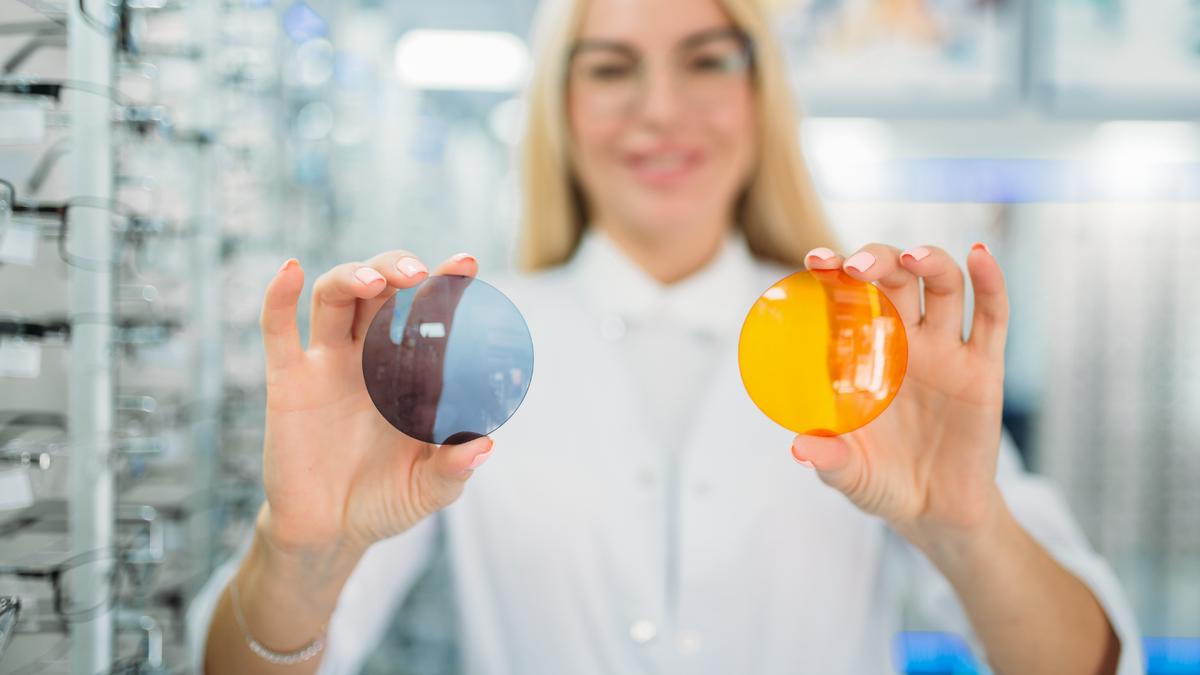
Features and origins of spectacle lenses
Spectacle lenses are the most important part of a pair of glasses, as they affect visual quality, wearing comfort and how well the glasses meet the wearer’s needs. Modern spectacle lenses are manufactured using both traditional and advanced technologies, and they can be produced in standard designs or individually tailored to the wearer.
Glasses were originally developed in northern Italy in the late 13th century to make reading easier and help with age-related difficulties in near vision. Over the centuries, glasses and lenses have evolved from simple visual aids into technologically advanced solutions whose features can be selected to suit the wearer’s needs. Today, there is a wide range of spectacle lenses available, from basic options to high-tech lenses that draw on the latest applied research, algorithms and surface manufacturing techniques – and everything in between.
Spectacle lenses are still manufactured using methods developed more than a hundred years ago. At the same time, lenses are also produced using continuously evolving advanced technologies. Although the differences are not visible from the outside, there can be significant differences between lenses.
Visual quality involves much more than visual acuity. A comprehensive eye examination identifies refractive errors such as hyperopia, myopia and astigmatism. Both traditionally manufactured and technologically advanced lenses can correct refractive errors and presbyopia. Both can achieve good visual acuity.
Traditional lens technology offers limited opportunities to improve vision beyond correcting refractive errors. Advanced technology, on the other hand, makes it possible to continuously improve lens features through various innovations and even with the help of artificial intelligence. It allows a very wide range of factors affecting visual quality to be taken into account, including the width of the clear field of vision, how easily the wearer can shift their gaze between different distances, and how effortless and comfortable vision is overall.
Advanced technology also enables the production of different lens designs. The lens design can be selected or fully customised to best suit the wearer’s lifestyle. For example, specialised glasses may be needed to support vision at work, while driving or during various hobbies.
Many factors affect lens quality. Individual needs, expectations and budgets vary. Opticians’ practices offer options at different price points and with a range of features, making it possible for each customer to find lenses that best suit their needs and budget.
Opticians’ practices can carry out measurements that are used to design and manufacture lenses tailored to the wearer and their individual needs. Individually customised lenses are designed according to the eye’s actual movement patterns rather than those of an average wearer, improving visual quality and wearing comfort.
The user’s individual near-vision habits can also be measured to provide the most natural possible visual experience at different viewing distances. As people read, use digital devices and view objects at close range in different ways, their near-vision requirements also vary. The measurements analyse factors such as the wearer’s typical reading distance, gaze direction and near-work habits.
The price of glasses is influenced by factors such as frame materials and manufacturing, lens design and features, as well as eye examinations, fitting and other services. One particularly important factor is whether the lenses are individually customised or standard, ready-made lenses. At an optician’s practice, customers can explore different options and, with professional guidance, choose glasses that suit their needs, preferences and budget. They can also receive help with adjustments and maintenance after purchase.
Glasses are a personal purchase that combines suitable frames, lenses designed for the wearer’s visual needs and professional expertise. At an optician’s practice, customers receive expert assistance in choosing suitable frames and lenses, as well as ensuring they are correctly measured and fitted. Eye examinations also support eye health and can identify a potential need for further investigations, in which case the customer is referred to an ophthalmologist.
Most glasses sold in Finland are manufactured in EU countries and Asia. The main countries of origin for lenses are Thailand, Poland and Germany. Frame manufacturing is concentrated in Italy, Sweden and China. Both spectacle lenses and frames are also manufactured in Finland.
Key countries of origin for glasses
| Country | Lenses, share by value | Frames, share by value |
|---|---|---|
| Poland | 28.48% | — |
| Germany | 15.14% | 0.19% |
| Hungary | 6.83% | 1.35% |
| France | 3.26% | 0.17% |
| Italy | 0.55% | 27.24% |
| Sweden | 0.13% | 33.65% |
| Denmark | 0.02% | 2.90% |
| Thailand | 43.67% | Less than 0.01% |
| China | 0.31% | 27.22% |
| India | 0.37% | Less than 0.01% |
| Vietnam | 0.29% | 0.11% |
| South Korea | Less than 0.01% | 3.40% |
| Japan | 0.13% | 1.82% |
The table presents a selection of key countries. A dash indicates a small share omitted from this presentation, not a verified zero. The detailed WITS tables above have been retained for comparison, but the countries should be interpreted as countries of origin.
Reproducibility and source
Source: Finnish Customs, Uljas, CN (2002–2025), cube 57, year 2024, statistical value in euros. Data retrieved on 21 October 2026. Version reported by the database: 2026-10-21T06:33:41.
- User interface: https://uljas.tulli.fi/v3rti/db/0/cubes/57
- API: POST https://uljas.tulli.fi/verti-tieto-0/api/dataset?language=en&format=json
- Products: CN6 900140 + 900150 (lenses) and 900311 + 900319 (frames).
- Trade flows: 1 = imports by country of origin; 3 = imports by country of consignment.
- Calculation method: Total import value for EU-27 countries divided by the total import value for all countries in the product group. The combined share is weighted by the import values of the product groups.
- Country-level values were summed, and the totals matched the overall totals for all countries in both product groups and under both country definitions.