



Instrumentarium recorded people’s blinking in two different situations: while calmly looking out of a window and while concentrating on computer work. The difference was significant: when looking at a screen, participants blinked an average of 60% less. The result illustrates one of the key reasons why dry eye is becoming increasingly common.
Many people feel that their eyes are tired or irritated at the end of a working day and assume this is simply a result of a demanding day. According to Instrumentarium optometrist Riikka Torvela, the cause is often something else: insufficient blinking.
“Your eyes shouldn’t feel uncomfortable, not even at the end of a working day. If your glasses prescription is up to date, the symptoms are most likely caused by dry eyes.”
“Eyes often become dry during screen-based work because people blink too little throughout the day, and even their blinks are often incomplete. The eyes become irritated when they are not adequately lubricated.”
Why does looking at a screen reduce blinking?
Blinking plays a crucial role in eye health. The eyelids spread the tear film evenly across the surface of the eye, helping to protect the eyes from drying out.
Concentrating on a screen at close range reduces the frequency of blinking and often causes blinks to be incomplete. As a result, the lower part of the cornea may remain dry despite blinking.
“When we are doing precise close-up work, the brain tries to keep our vision uninterrupted. The same thing happens when we concentrate on threading a needle.”
With screens, however, this intense close-up viewing can continue for exceptionally long periods. An uninterrupted stream of content does not provide natural breaks, and in today’s everyday life, people may spend as much as eight hours a day looking at screens.
“The eyes do recover even from a demanding day. The problem arises when the eyes remain in this exceptional state for hours every day, month after month and year after year.”
How the cycle of dry eye can begin
Screen time, reduced blinking and dry eye are strongly connected. A screen-heavy lifestyle can trigger a chain of events that increases the risk of dry eye.
“Our eyelids contain Meibomian glands, which release oil into the tear film with every blink. If you blink thousands of times too few every day, the oil in the glands can begin to thicken and the glands may become blocked. This can weaken the lipid layer of the tear film.”
When the lipid layer of the tear film becomes weaker, the eye needs more frequent, complete blinks to stay properly lubricated. With a screen-heavy lifestyle, the opposite often happens – and the cycle is complete.
“A healthy tear film remains intact on the surface of the eye for more than 10 seconds. In people with dry eye, the tear film can begin to break up within just a few seconds, allowing the eyes to dry out between blinks.”
Blinking less increases the number of people with dry eye
An international study* found that people who used screens for more than four hours a day had more Meibomian gland blockages and less oil in their tear film. In some participants, visible changes in the glands were detected after just 2–3 years of intensive screen-based work.
“The reduction in blinking caused by screen use is one of the main reasons why the number of people with dry eye is increasing in Finland and around the world.”
Torvela works at Instrumentarium’s Dry Eye Clinic. Every year, the clinic sees more young adults whose dry eye is primarily associated with high daily screen time.
“We see people in their twenties whose Meibomian glands are in worse condition than those of some older patients. In Finland, there is a growing number of mildly dry-eyed people aged 20–40 whose symptoms are likely to worsen as they reach middle age.”
“Vision has become an increasingly important tool for working. Dry eye could become a major challenge to people’s ability to work over the next decade.”
Optometrist Riikka Torvela’s four tips for screen users
1. When your eyes start to feel uncomfortable, squeeze them tightly shut.
“If your eyes start to feel dry, tired or irritated, give them some first aid with a proper blinking exercise. Squeeze your eyes tightly shut five times and then take a break from the screen.”
2. Take a screen break every 20 minutes.
“Take several short breaks throughout the day. Get up and move around, and let your gaze shift between different distances. As soon as you look away from the screen, your blinking starts to return to normal.”
3. Don’t hesitate to use lubricating eye drops.
“Lubricating eye drops can also help eyes that are affected by screen use. Use preservative-free lubricating eye drops recommended by an eye care professional. Keep the bottle next to your toothbrush, for example, so that you remember to use the drops regularly in the morning and evening. And remember to use them as needed throughout the day.”
4. Have persistently symptomatic eyes examined.
“Eyes that become tired or irritated during a day of screen work should be examined at a dry eye clinic. We estimate that as many as four out of five patients visiting Instrumentarium’s Dry Eye Clinics have an underlying Meibomian gland dysfunction. The good news is that blocked glands can be treated both at the clinic and with self-care at home.”
Instrumentarium’s blinking test
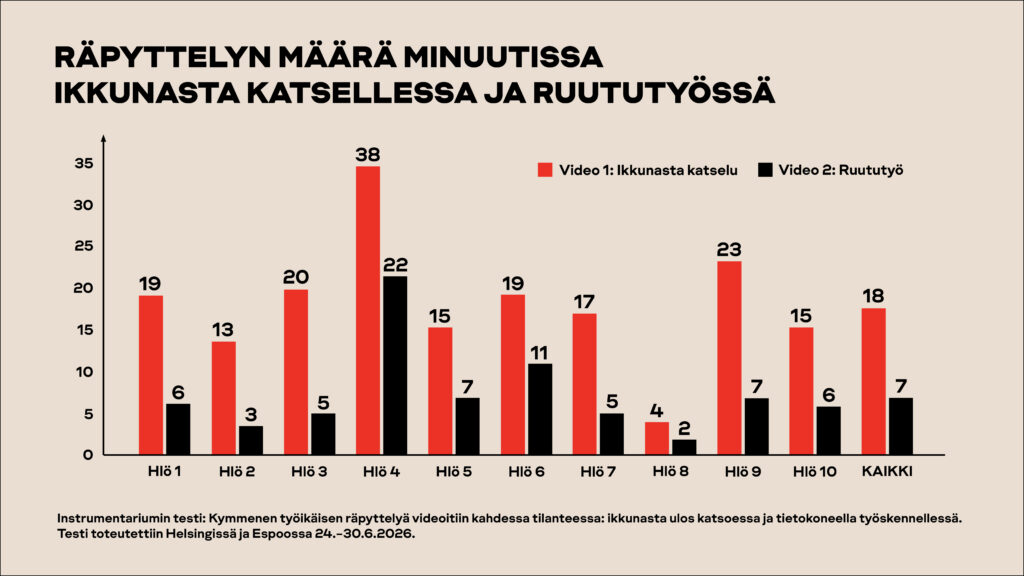
Instrumentarium recorded ten working-age people in two different situations: while calmly looking out of a window and while concentrating on computer work. The participants were not told the purpose of the recording. The videos were analysed to determine how many times the participants blinked per minute.
While looking out of the window, the participants blinked an average of 18 times per minute. When working at a computer, the average was just seven times per minute. Blinking decreased by 42–77% among the participants, with an average reduction of 60%.
“This sums up why dry eye is becoming more common,” says Riikka Torvela.
The findings are in line with those of a widely cited international study.** Instrumentarium’s test was conducted in Helsinki and Espoo between 24 and 30 June 2026.
Research sources:
* Wu et al. 2014. Meibomian Gland Dysfunction Determines the Severity of the Dry Eye Conditions in Visual Display Terminal Workers. https://pmc.ncbi.nlm.nih.gov/articles/PMC4140788
** Portello et al. 2013. Blink rate, incomplete blinks and computer vision syndrome. https://pubmed.ncbi.nlm.nih.gov/23538437
Further information
Riikka Torvela
Optometrist
riikka.torvela@instru.fi
Tel. +358 40 538 5108
Instrumentarium
Instrumentarium is a specialist optical retail chain owned by Instru Optiikka Oy. There are nearly 150 Instrumentarium stores in Finland and 29 in Estonia. Customers are served by more than 200 qualified optometrists and optical professionals. Several stores also have an ophthalmologist’s practice. Instrumentarium also operates nine Dry Eye Clinics. Instru Optiikka Oy is part of EssilorLuxottica.